
Read In English / हिन्दी में पढ़ें
The Deepest Part of the Ocean Is Deeper Than Mount Everest Is Tall
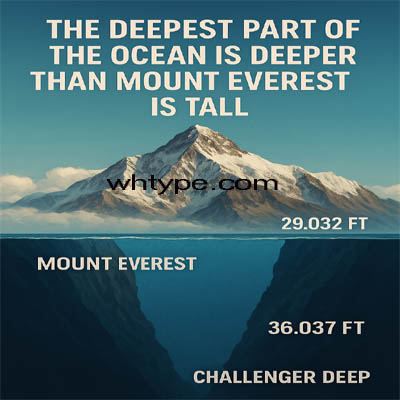
When we think of the tallest point on Earth, Mount Everest instantly comes to mind, towering at 8,848.86 meters (29,031.7 feet) above sea level. But few realize that Earth’s deepest natural point, the Mariana Trench, plunges significantly farther below sea level than Everest rises above it.
Challenger Deep – The Ocean’s Abyss
The Mariana Trench, located in the western Pacific Ocean, is home to the Challenger Deep, the deepest known point in Earth’s oceans.
- Depth of Challenger Deep: Approximately 10,984 meters (36,037 feet)
- Height of Mount Everest: 8,848.86 meters (29,031.7 feet)
This means the Challenger Deep is over 2 km deeper than Everest is tall.
Scientific Measurements
The most accurate measurements have come from multiple expeditions:
- 1960 – The first manned descent was made by Jacques Piccard and Don Walsh aboard the Bathyscaphe Trieste.
- 2012 – James Cameron, the filmmaker and explorer, completed a solo dive to Challenger Deep.
- Recent – Robotic submersibles like DSV Limiting Factor have mapped the trench using sonar and pressure sensors with high precision.
Environmental Extremes
Challenger Deep presents some of the harshest conditions on Earth:
- Pressure: Over 1,100 atmospheres (8 tons per square inch)
- Temperature: Near freezing, 1–4°C
- Light: Complete darkness
- Life: Despite the hostile conditions, microbial and invertebrate life forms have been discovered, showing remarkable adaptations.
Why It Matters
Studying the Mariana Trench helps scientists:
- Understand plate tectonics and subduction zones
- Discover extremophile organisms that can survive without sunlight
- Improve engineering for deep-sea exploration and materials science
Conclusion
While Mount Everest may be Earth’s tallest point above sea level, the Challenger Deep in the Mariana Trench takes the title for greatest depth below sea level—a true extreme frontier of our planet. With depths nearly 11 kilometers below the surface, it humbles even the mightiest mountain.
References:
- NOAA National Centers for Environmental Information: https://www.ngdc.noaa.gov/mgg/mariana/
- National Geographic: https://www.nationalgeographic.com
- US Geological Survey (USGS): https://www.usgs.gov
समुद्र का सबसे गहरा हिस्सा, माउंट एवरेस्ट से भी अधिक गहरा है
Read In English / हिन्दी में पढ़ें
जब हम पृथ्वी की सबसे ऊँची जगह की बात करते हैं, तो हमारा ध्यान तुरंत माउंट एवरेस्ट की ओर जाता है, जिसकी ऊँचाई समुद्र तल से 8,848.86 मीटर (29,031.7 फीट) है। लेकिन बहुत कम लोग जानते हैं कि पृथ्वी का सबसे गहरा बिंदु समुद्र की सतह के नीचे है — मैरियाना ट्रेंच में स्थित चैलेंजर डीप, जो एवरेस्ट की ऊँचाई से भी अधिक गहरा है।
चैलेंजर डीप – महासागर की गहराई की चरम सीमा
मैरियाना ट्रेंच, प्रशांत महासागर के पश्चिमी भाग में स्थित है और इसमें मौजूद चैलेंजर डीप को समुद्र की सबसे गहरी ज्ञात जगह माना जाता है।
- चैलेंजर डीप की गहराई: लगभग 10,984 मीटर (36,037 फीट)
- माउंट एवरेस्ट की ऊँचाई: 8,848.86 मीटर (29,031.7 फीट)
यह अंतर लगभग 2 किलोमीटर का है — यानी चैलेंजर डीप माउंट एवरेस्ट की ऊँचाई से भी ज़्यादा नीचे है।
वैज्ञानिक माप और अभियान
इस गहराई को मापने और अध्ययन करने के लिए कई अभियानों का सहारा लिया गया है:
- 1960 – बैथिसकैफ त्रिएस्टे नामक सबमरीन से जैक्स पिकार्ड और डॉन वॉल्श ने पहली मानवयुक्त डुबकी लगाई।
- 2012 – फिल्म निर्माता जेम्स कैमरून ने अकेले ही चैलेंजर डीप की यात्रा की।
- हाल ही में – DSV Limiting Factor जैसे रोबोटिक सबमरीन ने उच्च सटीकता से मैपिंग की।
पर्यावरणीय चरम स्थितियाँ
चैलेंजर डीप में पृथ्वी की सबसे कठोर परिस्थितियाँ पाई जाती हैं:
- दबाव: लगभग 1,100 वायुमंडलीय दबाव (प्रति वर्ग इंच 8 टन)
- तापमान: लगभग 1–4 डिग्री सेल्सियस
- प्रकाश: पूर्ण अंधकार
- जीवन: यहाँ पर सूक्ष्म जीव और अकशेरुकी पाए गए हैं, जो अत्यंत कठोर परिस्थितियों में भी जीवित रहते हैं।
क्यों है यह महत्वपूर्ण?
मैरियाना ट्रेंच का अध्ययन वैज्ञानिकों को निम्नलिखित में मदद करता है:
- प्लेट टेक्टोनिक्स और सबडक्शन ज़ोन को समझना
- चरम परिस्थितियों में जीवों का अन्वेषण
- डीप-सी इंजीनियरिंग और नई सामग्री तकनीक का विकास
निष्कर्ष
जहाँ माउंट एवरेस्ट समुद्र तल से पृथ्वी की सबसे ऊँची चोटी है, वहीं चैलेंजर डीप समुद्र की सबसे गहरी खाई है — यह हमारी धरती का एक ऐसा हिस्सा है जो आज भी रहस्यमय बना हुआ है। इसकी गहराई लगभग 11 किलोमीटर है, जो किसी भी पर्वत की ऊँचाई से अधिक प्रभावशाली है।
स्रोत (Sources):
- NOAA – National Centers for Environmental Information:
https://www.ngdc.noaa.gov/mgg/mariana/ - National Geographic:
https://www.nationalgeographic.com - USGS – US Geological Survey:
https://www.usgs.gov
































































 WH Type
Leave a comment