
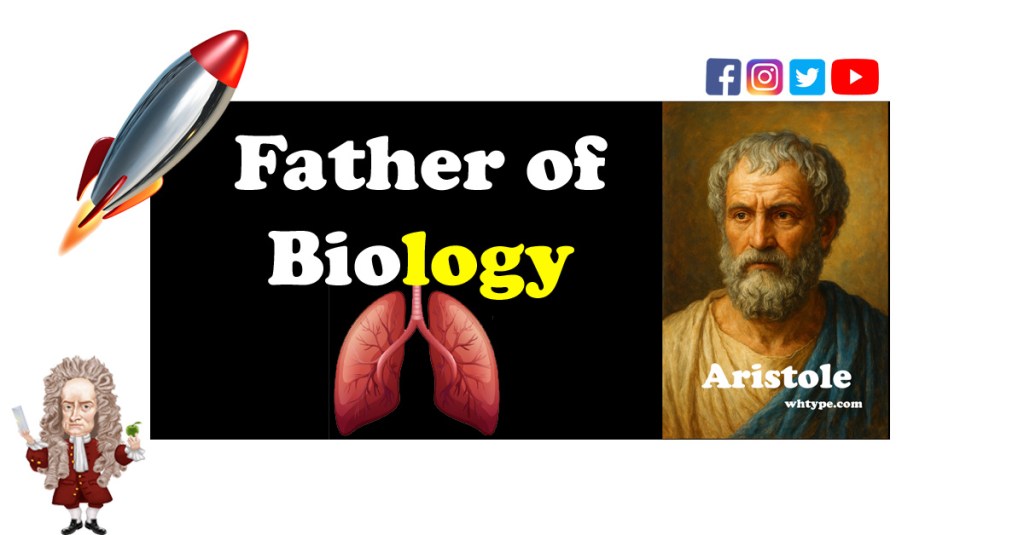
Aristotle: Father of Biology
When we think about the origins of biology, one name stands out above all—Aristotle. Often called the “Father of Biology”, Aristotle was not just a philosopher but also the first great scientist who systematically studied living organisms. His contributions laid the foundation for biology as a science. In this post, we’ll explore who Aristotle was, why he is called the father of biology, his works, discoveries, and lasting influence on science.

Who Was Aristotle?
- Full Name: Aristotle (Greek: Ἀριστοτέλης)
- Born: 384 BCE in Stagira, Greece
- Died: 322 BCE in Euboea, Greece
- Profession: Philosopher, Teacher, Scientist
- Student of: Plato
- Teacher of: Alexander the Great
Aristotle was a Greek philosopher who made groundbreaking contributions to logic, metaphysics, politics, ethics, and natural sciences, including biology.
Why Is Aristotle Called the Father of Biology?
Aristotle is regarded as the Father of Biology because:
- He was the first to systematically study and classify living organisms.
- He described over 500 species of animals in detail.
- He introduced the first scientific method of observation and comparison in biology.
- His writings influenced science for more than 2,000 years.
Aristotle’s Contribution to Biology
1. Classification of Animals
Aristotle divided animals into two main groups:
- Anaima (Bloodless animals): Invertebrates
- Enaima (Blooded animals): Vertebrates
This was the earliest attempt to classify living organisms scientifically.
2. Systematic Observation
He carefully observed the anatomy, habits, and habitats of animals. For example:
- Described the development of chick embryos.
- Studied marine animals like octopus, cuttlefish, and crustaceans.
3. Foundation of Zoology
Aristotle is also called the Father of Zoology because he documented animal structures, reproduction, and behavior.
4. First Biological Writings
His famous works on biology include:
- Historia Animalium (History of Animals)
- Parts of Animals
- Generation of Animals
These books became the first textbooks of biology in history.
Important Facts About Aristotle’s Biology
- He believed life originated from the sea.
- He was the first to study the nervous system and heartbeat.
- He discovered that whales and dolphins are mammals, not fish.
- His method was based on empirical observation (direct study of nature).
- Many of his ideas were later corrected, but his scientific spirit remains unmatched.
Aristotle’s Influence on Modern Biology
- His biological works inspired scientists of the Islamic Golden Age and European Renaissance.
- Naturalists like Charles Darwin acknowledged his importance.
- Even though modern science has advanced, Aristotle’s systematic method of study still forms the basis of biology.
FAQs About Aristotle and Biology
Q1. Who is called the father of biology?
Aristotle is called the Father of Biology.
Q2. Who is the father of zoology?
Aristotle is also considered the Father of Zoology.
Q3. What is Aristotle’s most famous biological work?
Historia Animalium (History of Animals).
Q4. Who was Aristotle’s teacher?
Plato.
Q5. Who was Aristotle’s student?
Alexander the Great.
Conclusion
Aristotle’s legacy as the Father of Biology lies not just in his writings but in his approach—to observe, record, and classify living beings systematically. His work shaped the foundation of life sciences and influenced countless scholars for centuries. Even today, Aristotle remains a symbol of curiosity, logic, and the pursuit of knowledge.
Read More Learn More

Father of Physics – Galileo Galilei
The title “Father of Physics” is often given to Galileo Galilei (1564–1642), the great Italian scientist who revolutionized the way we study nature. He is regarded as one of the…
Keep reading
Who is The Father of Taxonomy
Learn about Carl Linnaeus, the Father of Taxonomy. Discover his contributions, binomial nomenclature system, famous works (Systema Naturae, Species Plantarum), and his lasting influence on biological classification.
Keep readingWho is The Father of Modern Botany
Discover Carl Linnaeus, the Father of Modern Botany. Learn about his contributions, works (Species Plantarum, Systema Naturae), binomial nomenclature, and lasting influence on plant science.
Keep reading
Who is the father of botany
Discover Theophrastus, the Father of Botany. Learn about his contributions, works (Historia Plantarum, De Causis Plantarum), classification of plants, and his lasting influence on plant science.
Keep reading





























































 WH Type
Leave a comment