

Who is the father of physics?
The title “Father of Physics” is often given to Galileo Galilei (1564–1642), the great Italian scientist who revolutionized the way we study nature. He is regarded as one of the most influential figures in the history of science because of his pioneering contributions in physics, astronomy, mathematics, and scientific methodology. Galileo introduced experiments, observations, and logical reasoning as the true path of science, replacing blind faith in old theories.
Early Life and Education
- Born: 15 February 1564, Pisa, Italy
- Parents: Vincenzo Galilei (musician and scholar) and Giulia Ammannati
- Initially studied medicine at the University of Pisa, but later shifted to mathematics and natural philosophy.
- His curiosity for mechanical devices and natural phenomena shaped his career as a physicist and inventor.
Why is Galileo Called the “Father of Physics”?
Galileo is called the Father of Physics because he laid the foundation of modern experimental science. Before him, natural philosophy was largely theoretical and based on Aristotle’s ideas. Galileo introduced:
- Systematic experimentation instead of assumptions.
- Mathematical analysis of physical phenomena.
- Discovery of fundamental concepts like inertia, acceleration, relativity, and motion of bodies.
- His work prepared the path for Isaac Newton’s laws of motion and gravitation.
Major Contributions of Galileo Galilei
1. Laws of Motion
- Demonstrated that all objects fall at the same rate regardless of mass (contradicting Aristotle).
- Discovered the principle of inertia (an object remains in motion unless acted upon by an external force).
- Studied uniformly accelerated motion and laid the groundwork for Newton’s First Law.
2. Astronomy
- Improved the design of the telescope in 1609.
- Observed:
- Moons of Jupiter (Galilean moons)
- Phases of Venus
- Mountains and craters on the Moon
- Sunspots
- Supported Heliocentric Theory of Copernicus (Earth revolves around the Sun), which was revolutionary at that time.
3. Scientific Method
- Emphasized observation, experimentation, and mathematics as the foundation of science.
- Rejected blind belief in authority.
- His methodology inspired future scientists and gave birth to modern physics.
4. Inventions and Discoveries
- Thermoscope (early thermometer)
- Military compass
- Improvements in telescope design
- Principles of pendulum motion (later used in clocks)
Conflict with the Church
Galileo’s support for heliocentrism brought him into conflict with the Catholic Church, which believed in the geocentric model (Earth as the center of the universe).
- In 1633, he was tried by the Roman Inquisition and forced to retract his views.
- He spent the last years of his life under house arrest, but continued scientific work.
Legacy of Galileo Galilei
- Known as the Father of Modern Physics, Father of Modern Science, and Father of Observational Astronomy.
- His discoveries paved the way for Newton, Einstein, and all future physicists.
- Galileo remains a symbol of scientific courage and freedom of thought against dogma.
Famous Quote by Galileo
“All truths are easy to understand once they are discovered; the point is to discover them.”
Conclusion
Galileo Galilei’s life and work marked a turning point in human history. He transformed physics from philosophy into an experimental, mathematical science. That’s why the world remembers him as the Father of Physics, whose vision of truth still inspires scientists, students, and thinkers.
Read More Learn More

Who is The Father of Taxonomy
Learn about Carl Linnaeus, the Father of Taxonomy. Discover his contributions, binomial nomenclature system, famous works (Systema Naturae, Species Plantarum), and his lasting influence on biological classification.
Keep readingWho is The Father of Modern Botany
Discover Carl Linnaeus, the Father of Modern Botany. Learn about his contributions, works (Species Plantarum, Systema Naturae), binomial nomenclature, and lasting influence on plant science.
Keep reading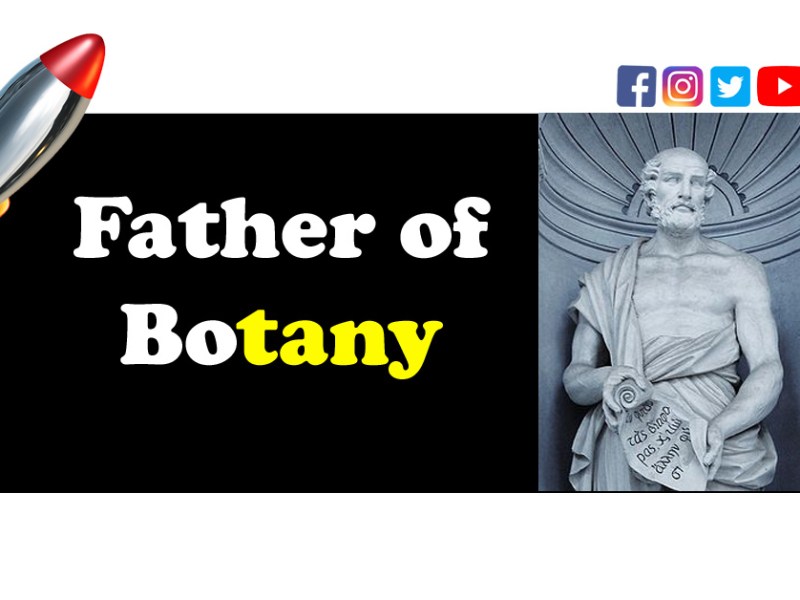
Who is the father of botany
Discover Theophrastus, the Father of Botany. Learn about his contributions, works (Historia Plantarum, De Causis Plantarum), classification of plants, and his lasting influence on plant science.
Keep reading
Who is The Father of Biology
Learn why Aristotle is called the Father of Biology. Discover his contributions, works, discoveries, and lasting influence on science and zoology.
Keep reading



























































 WH Type
Leave a comment