
Introduction
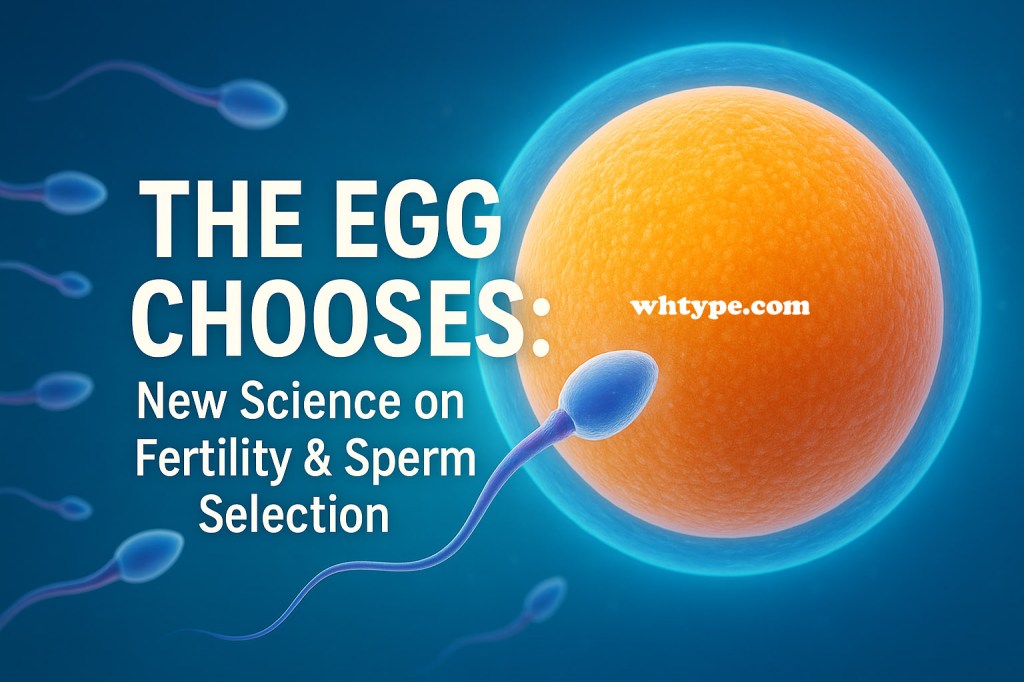
For decades, we’ve believed in the “sperm race” myth—millions of sperm rushing toward the egg, with the fastest one winning. But cutting-edge research has flipped this narrative.
A landmark Stockholm University study (2020) revealed that human eggs release chemical signals that attract certain sperm more than others. In other words, the egg doesn’t just wait passively—it may choose which sperm fertilizes it.
This discovery has profound implications for our understanding of fertility, conception, IVF treatments, and even evolution.
What Is the “Sperm Race” Myth?
- Traditional belief: Fertilization is a race, and the fastest sperm wins.
- Reality: The egg plays an active role in guiding sperm using chemical attractants.
- New perspective: Fertilization is less about speed, more about biological compatibility.
The Study: How Eggs Attract Sperm
Researchers at Stockholm University and Manchester University NHS Foundation Trust studied the follicular fluid that surrounds human eggs.
Key Findings:
- Follicular fluid releases chemoattractants that draw sperm.
- Eggs from different women attracted sperm from different men—individual preference exists at the gamete level.
- Sometimes, a woman’s egg attracted sperm from a man other than her partner more strongly.
- The egg’s choice was not linked to sperm speed or health alone, but rather to biochemical compatibility.
This phenomenon is called “gamete-mediated mate choice” or “cryptic female choice.”

Why Do Eggs Prefer Certain Sperm?
Scientists believe this selectivity is nature’s way of ensuring the healthiest and most genetically compatible match.
- Genetic compatibility: Eggs may attract sperm carrying complementary immune genes.
- Evolutionary advantage: Increases chances of a healthy embryo and successful pregnancy.
- Fertility impact: Explains why some couples struggle with unexplained infertility.
Also Read : Who is The Father of Biology
Egg Chooses Sperm vs. IVF
In in vitro fertilization (IVF), sperm are often chosen based on their appearance or motility under a microscope. But this research suggests that:
- The egg’s natural selection process is bypassed in IVF.
- Understanding chemical attraction could improve IVF success rates.
- Future fertility treatments may use follicular fluid cues to identify the most compatible sperm.
The Egg Doesn’t “Reject” Sperm—It Attracts Differently
It’s important to clarify: eggs don’t aggressively “reject” sperm. Instead, they create microenvironments that make it easier for some sperm to reach them than others.
Think of it as chemical matchmaking rather than a battlefield.
Implications for Fertility & Evolution
- For Fertility: Couples facing unexplained infertility may actually be experiencing egg–sperm incompatibility at the chemical level.
- For Evolution: This hidden selection could shape human reproduction by favoring stronger genetic combinations.
- For Science: Challenges the idea that fertilization is random—showing that female biology has more influence than we thought.
Breaking the Myths About Fertilization
- ❌ Myth: The fastest sperm always wins.
- ✅ Truth: The egg’s chemical signals influence which sperm gets close.
- ❌ Myth: Eggs are passive.
- ✅ Truth: Eggs are active players in fertilization.
- ❌ Myth: Fertilization is purely chance.
- ✅ Truth: Biology involves selectivity and compatibility.
Conclusion
The discovery that eggs can attract certain sperm revolutionizes how we understand conception, fertility, and reproduction.
It’s no longer just a sperm race—it’s a biological matchmaking process, with the egg holding the power of selection.
This breakthrough reshapes fertility science, opens new doors for IVF treatment, and deepens our appreciation of the hidden complexity behind the miracle of life.
Find More :
- How to Combine Colors: Complete Guide to Creating New Colors
- How to Use AI for Stock Trading: Complete Guide
- Father of Physics – Galileo Galilei
- Who is The Father of Biology
- What Happens If You Never Throw Away Your Phone Number?
Explore More on WHTYPE Blog :


















Something went wrong. Please refresh the page and/or try again.

















































 WH Type
Leave a comment