
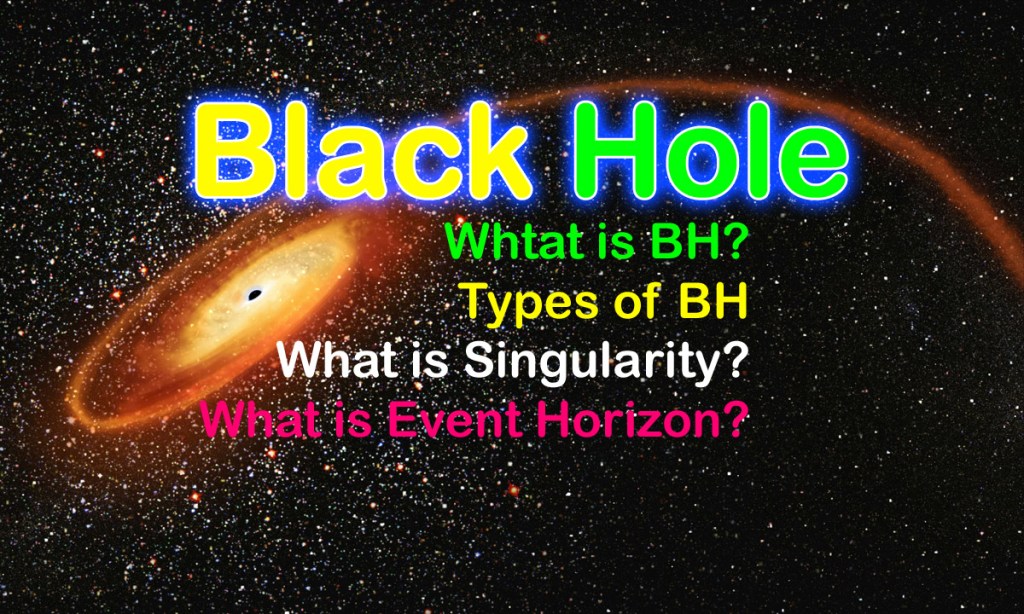
Black holes are among the most mysterious and fascinating objects in our universe. They challenge our understanding of physics, space, time, and reality itself. In this blog, we’ll answer all the important questions about black holes, including their formation, types, properties, and why they are so powerful yet not a threat to Earth.
What is a Black Hole?
A black hole is a region in space where gravity is so strong that nothing—not even light—can escape from it. This extreme gravitational pull is created when a massive amount of matter is compressed into a very small area. Black holes are invisible to the naked eye, but scientists detect them by studying their effects on nearby stars, gas, and radiation.
How are Black Holes Formed?
Black holes are usually formed from the death of massive stars. When a star at least 20 times more massive than our Sun runs out of nuclear fuel, it can no longer resist its own gravity. The core collapses, and if the mass is high enough, it compresses into an infinitely dense point called a singularity, forming a black hole.
What are the Types of Black Holes?
There are mainly four types of black holes:
- Stellar Black Holes – Formed when massive stars collapse.
- Supermassive Black Holes – Found at the centers of galaxies, including our Milky Way. They contain millions to billions of solar masses.
- Intermediate Black Holes – Formed when several smaller black holes merge.
- Primordial Black Holes – Hypothetical black holes formed just after the Big Bang.
What are the Properties of Black Holes?
Some unique properties of black holes include:
- Event Horizon: The boundary beyond which nothing can escape.
- Singularity: The infinitely dense point at the center.
- Immense Gravity: Strong enough to bend space and time.
- No Physical Surface: Black holes don’t have a solid surface like stars or planets.
- Accretion Disk: Superheated matter swirling around the black hole before falling in.
Why are Black Holes Dangerous?
Black holes are dangerous because of their extreme gravitational pull. Anything that gets too close—stars, planets, or even light—will be pulled inside. They can also emit deadly radiation jets when feeding on matter. However, since the nearest black hole is thousands of light-years away, Earth is not in any danger.
Why Don’t Black Holes Attract Earth, the Sun, or Our Solar System?
Black holes do not “suck” everything in like a cosmic vacuum cleaner. Their gravitational pull works just like any other object with mass. Unless our solar system moves dangerously close to a black hole, its effect on Earth and the Sun is negligible. The Milky Way’s central supermassive black hole is 26,000 light-years away, far too distant to affect us.
Why Can’t Light Escape from a Black Hole?
Light cannot escape a black hole because the escape velocity (the speed required to break free) is greater than the speed of light itself. Since nothing can travel faster than light, once light crosses the event horizon, it is trapped forever.
What is Singularity in a Black Hole?
The singularity is the core of a black hole, where matter is crushed into a point of infinite density. At this point, our known laws of physics break down. It is a place where space and time themselves cease to exist in the way we understand.
What is the Event Horizon of a Black Hole?
The event horizon is the boundary around a black hole. It acts as the “point of no return.” Once an object crosses the event horizon, it cannot escape, not even light. To an outside observer, anything approaching the event horizon appears to slow down and fade.
Why is Gravity So High in a Black Hole?
The gravity of a black hole is so high because an enormous amount of mass is compressed into a very tiny volume. The smaller the radius and the greater the mass, the stronger the gravity. This intense gravitational field warps space-time to extreme levels.
What Happens to Space and Time Inside a Black Hole?
Inside a black hole, space and time behave differently. According to Einstein’s theory of relativity:
- Time slows down dramatically near the event horizon.
- Space becomes curved so strongly that all paths lead to the singularity.
- Inside the event horizon, the concept of “future” points only inward, meaning everything must fall toward the singularity.
Why Do Black Holes Not Have Any Surface?
Unlike planets or stars, black holes do not have a solid surface. Instead, they have the event horizon, which acts as a boundary. Anything crossing it is pulled inward with no chance of return. If you fall into a black hole, you won’t land on a surface—you’ll simply be stretched and compressed until reaching the singularity.
Conclusion
Black holes are mysterious, powerful, and awe-inspiring cosmic objects. They teach us about gravity, relativity, space, and time. While they may seem dangerous, black holes are far away and pose no threat to Earth. Instead, they remain one of the most exciting frontiers of modern astronomy and physics.


































































 WH Type
Leave a comment