
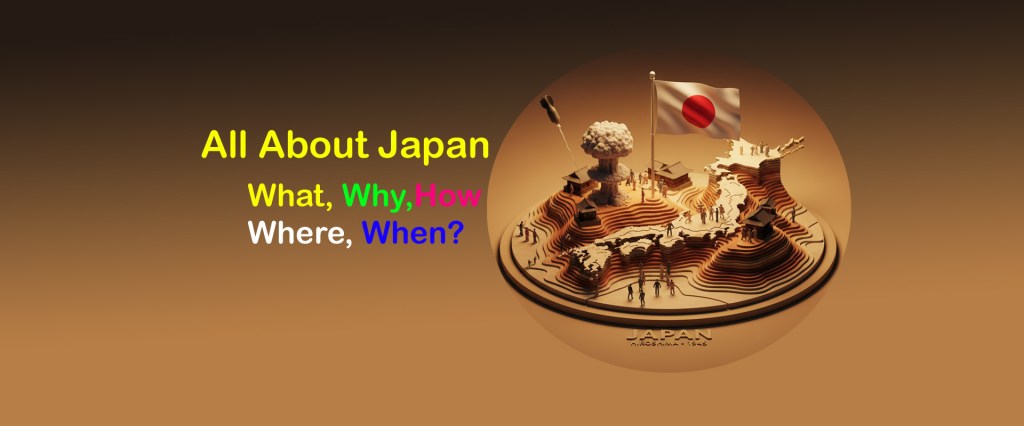
We Will Learn :
- All About Japan : What Questions
- All About Japan : Why Questions
- All About Japan : How Questions
- All About Japan : Where Questions
- All About Japan : When Questions
- All About Japan : Which Questions
🗾 All About Japan: What Questions
What is Japan?
Japan is an island country in East Asia, located in the Pacific Ocean. It is made up of thousands of islands, with four main ones — Honshu, Hokkaido, Kyushu, and Shikoku. Japan is known for its advanced technology, ancient traditions, and unique blend of modern and historical culture.
What is Japan famous for?
Japan is famous for its cherry blossoms, Mount Fuji, sushi, samurai culture, anime and manga, bullet trains (Shinkansen), traditional tea ceremonies, kimonos, and high-tech cities like Tokyo and Osaka.
What is the capital of Japan?
The capital of Japan is Tokyo, one of the world’s largest and most advanced cities, known for its skyscrapers, technology, fashion, food, and culture.
What does Japan mean?
The word Japan (日本, pronounced Nihon or Nippon) means “origin of the sun,” which is why Japan is called the Land of the Rising Sun.
What is the population of Japan?
As of 2025, Japan’s population is around 124 million people, making it the 12th most populous country in the world.
What language is spoken in Japan?
The official language of Japan is Japanese (Nihongo). English is taught in schools and used in major tourist areas, but not widely spoken in rural regions.
What is the currency of Japan?
The currency of Japan is the Japanese Yen (¥ / JPY).
What religion is followed in Japan?
Japan has two main religions — Shinto (the indigenous faith) and Buddhism. Many Japanese people practice a mix of both, along with modern secular lifestyles.
What type of government does Japan have?
Japan is a constitutional monarchy with a parliamentary government. The Emperor is the ceremonial head of state, while the Prime Minister and the Diet (parliament) handle governance.
What is Japan’s national flower?
The cherry blossom (Sakura) is Japan’s national flower, symbolizing beauty, renewal, and the fleeting nature of life.
What is Japan’s national animal?
The Japanese macaque, also called the snow monkey, is considered Japan’s national animal.
What is Japan’s national sport?
Sumo wrestling is Japan’s national sport. It originated centuries ago and is deeply rooted in Japanese culture and Shinto rituals.
What is Japan’s climate like?
Japan has a temperate climate with four distinct seasons — spring (mild, cherry blossoms), summer (hot and humid), autumn (cool with colorful leaves), and winter (cold and snowy in the north).
What is Japan’s geography like?
Japan is a mountainous island nation, with about 70% of its land covered by forests and mountains. It lies on the Pacific Ring of Fire, making earthquakes and volcanoes common.
What is Japan’s highest mountain?
Mount Fuji (Fujisan) is Japan’s highest mountain at 3,776 meters (12,389 ft). It’s also a UNESCO World Heritage Site and a sacred symbol of Japan.
What is Japan’s main food?
Japanese cuisine includes rice, fish, vegetables, miso soup, sushi, sashimi, ramen, tempura, and bento meals. It focuses on balance, presentation, and freshness.
What is Japan’s traditional clothing?
The traditional Japanese dress is the Kimono, a long robe with wide sleeves tied with a sash called an Obi. It’s worn on festivals, ceremonies, and special occasions.
What is Japan’s famous festival?
Some of Japan’s most famous festivals include:
- Hanami (Cherry Blossom Viewing)
- Gion Matsuri (Kyoto)
- Tanabata Festival
- Obon (Festival of the Dead)
- Snow Festival (Sapporo)
What is Japan’s economy based on?
Japan’s economy is based on manufacturing, technology, robotics, automobiles, electronics, and export industries. Tourism and services also play a major role.
What is Japan’s GDP ranking in the world?
As of 2025, Japan is the third-largest economy in the world after the United States and China.
What is Japan known for technologically?
Japan is known for robotics, high-speed trains, electronics, automobiles, and AI innovation. Brands like Toyota, Sony, Honda, and Panasonic are global leaders.
What is Japan’s flag?
Japan’s flag is a white rectangle with a red circle in the center, representing the rising sun. It’s called Hinomaru (日章旗).
What is Japan’s education system like?
Japan’s education system is structured as 6 years of elementary school, 3 years of junior high, 3 years of high school, and 4 years of university. It’s known for discipline, quality, and technology integration.
What is Japan’s transportation like?
Japan has one of the world’s best transportation systems, including bullet trains (Shinkansen), subways, buses, and domestic flights. Public transport is punctual, clean, and safe.
What is Japan’s culture known for?
Japanese culture is known for discipline, respect, politeness, harmony, and cleanliness. It beautifully blends ancient traditions with modern lifestyle — from samurai and tea ceremonies to anime and robots.
What is Japan’s traditional art?
Traditional Japanese arts include Ikebana (flower arrangement), Origami (paper folding), Calligraphy, Kabuki theatre, and Tea ceremony.
What is Japan’s famous drink?
Japan’s famous drinks include Green tea (Matcha), Sake (rice wine), and Shochu.
What is Japan’s major religion festival?
Shinto festivals (Matsuri) are held at shrines throughout Japan, celebrating seasonal changes, harvests, and local deities.
What is Japan’s time zone?
Japan is in the Japan Standard Time (JST) zone, which is UTC +9 hours.
What is Japan’s writing system?
Japanese writing uses three scripts:
- Kanji (Chinese characters),
- Hiragana, and
- Katakana (for foreign words).
What is Japan’s famous food culture called?
Japanese cuisine, known as Washoku (和食), emphasizes seasonal ingredients, presentation, and nutrition. It’s recognized by UNESCO as an Intangible Cultural Heritage.
What is Japan’s life expectancy?
Japan has one of the world’s highest life expectancies — about 85 years on average.
What is Japan’s traditional music called?
Traditional Japanese music includes Gagaku (court music), Shamisen performances, and Taiko drumming.
What is Japan’s most visited city?
Tokyo is the most visited city in Japan, followed by Kyoto, Osaka, and Nara for their cultural and historical attractions.
What is Japan’s most famous landmark?
Mount Fuji, Tokyo Tower, Fushimi Inari Shrine, and Himeji Castle are among Japan’s most iconic landmarks.
What is Japan’s bullet train speed?
Japan’s Shinkansen (bullet train) runs at speeds up to 320 km/h (200 mph) and is world-famous for punctuality and safety.
What is Japan’s literacy rate?
Japan has an almost 100% literacy rate, among the highest in the world.
What is Japan’s national dish?
Curry rice (Kare Raisu) and Sushi are both considered national dishes of Japan.
What is Japan’s famous street food?
Popular Japanese street foods include Takoyaki (octopus balls), Okonomiyaki (savory pancakes), Yakitori (grilled chicken skewers), and Taiyaki (fish-shaped cake).
What is Japan’s role in World War II?
Japan was part of the Axis Powers during World War II. The war ended after the atomic bombings of Hiroshima and Nagasaki in 1945, after which Japan adopted a pacifist constitution.
What is Japan’s post-war development called?
Japan’s post-war period is known as the Japanese Economic Miracle (1950s–1980s), marked by rapid industrial growth and modernization.
What is Japan’s currency value compared to USD?
As of 2025, 1 USD ≈ 150 JPY (approximate and fluctuates).
What is Japan’s biggest island?
Honshu is Japan’s largest and most populated island, home to cities like Tokyo, Kyoto, and Osaka.
What is Japan’s most common mode of travel?
Trains and subways are the most common, efficient, and affordable ways to travel in Japan.
What is Japan’s major export?
Japan’s major exports include automobiles, machinery, electronics, and semiconductors.
What is Japan’s famous technology brand?
Famous Japanese technology brands include Sony, Panasonic, Toshiba, Canon, and Fujitsu.
What is Japan’s famous car brand?
Japan is home to world-famous car manufacturers such as Toyota, Honda, Nissan, Mazda, and Subaru.
What is Japan’s famous anime industry?
Japan’s anime industry is globally influential, producing world-known series like Naruto, One Piece, Attack on Titan, and Demon Slayer.
What is Japan’s most sacred religion site?
Ise Grand Shrine (Ise Jingu) is considered the most sacred Shinto shrine in Japan.
What is Japan’s traditional house called?
Traditional Japanese houses are called Minka, featuring tatami mats, sliding doors, and wooden structures.
What is Japan’s famous shopping area?
Shibuya and Shinjuku (Tokyo) are major shopping and entertainment hubs in Japan.
What is Japan’s work culture like?
Japanese work culture values discipline, punctuality, dedication, teamwork, and long working hours — though work-life balance is slowly improving.
What is Japan’s biggest challenge today?
Japan faces challenges like an aging population, labor shortage, and low birth rate, impacting its economy and social systems.
What is Japan’s relationship with India?
Japan and India share strong ties in trade, technology, education, and cultural exchange, with Japan being a key investor in India’s infrastructure projects.
🇯🇵 All About Japan: Why Questions
Why is Japan called Japan?
Japan is called “Japan” because of the Portuguese pronunciation of the Mandarin word Cipangu, derived from the Chinese Rìběn (日本), meaning “origin of the sun.” In Japanese, Nihon or Nippon means “sun’s origin,” which led to Japan being called “The Land of the Rising Sun.”
Why is Japan known as the Land of the Rising Sun?
The name comes from its eastern location relative to the Asian continent. Since the sun rises in the east, ancient Chinese texts referred to Japan as the place where the sun rises — hence “Land of the Rising Sun.”
Why is Japan so clean?
Cleanliness in Japan is a deeply rooted cultural value. From childhood, students clean their schools, and adults maintain public order. Shinto beliefs also link cleanliness to spiritual purity, making hygiene and order part of daily life.
Why is Japan so safe?
Japan has one of the world’s lowest crime rates. This is due to strict laws, social harmony, respect for rules, and strong community policing. Cultural emphasis on shame and moral responsibility also discourages wrongdoing.
Why is Japan so expensive?
Japan is expensive because of high living standards, limited land, import costs, and strong demand for quality goods and services. Cities like Tokyo have high real estate prices, but public services and infrastructure are exceptional.
Why is Japan so technologically advanced?
Japan invests heavily in research and development, robotics, and automation. The government, industries, and universities work together to innovate. The post-war focus on efficiency and precision also contributed to its tech leadership.
Why do Japanese people live so long?
The Japanese diet — rich in fish, vegetables, tofu, and green tea — combined with active lifestyles, low obesity, strong healthcare, and social support systems contribute to Japan’s world-leading life expectancy.
Why do Japanese people bow?
Bowing (ojigi) in Japan is a sign of respect, gratitude, or apology. It replaces handshakes and expresses humility, harmony, and cultural politeness, reflecting the value of respect in Japanese society.
Why do Japanese wear masks even before COVID-19?
Masks are worn to prevent spreading illness, protect from pollution and pollen, and maintain privacy. It’s a socially considerate practice showing respect for others’ health and comfort.
Why does Japan have earthquakes so often?
Japan lies on the Pacific “Ring of Fire,” where four major tectonic plates meet. This geological setting causes frequent earthquakes and volcanic activity.
Why does Japan have so many vending machines?
Japan’s high population density, safety, and technological innovation allow vending machines to thrive. They’re convenient, theft-resistant, and offer everything from drinks to umbrellas.
Why are Japanese toilets famous?
Japanese toilets are famous for their advanced features — heated seats, bidet functions, automatic lids, and sound effects — all designed for hygiene and comfort.
Why do Japanese eat raw fish?
Raw fish (sashimi or sushi) reflects freshness, natural flavor, and respect for ingredients. Japan’s access to fresh seafood and long tradition of culinary craftsmanship make raw fish central to its cuisine.
Why are Japanese gardens so beautiful?
Japanese gardens reflect harmony with nature. Each element — water, rocks, plants — symbolizes peace and balance, inspired by Zen Buddhism and Shinto aesthetics.
Why do Japanese people take off shoes indoors?
Shoes are removed indoors to maintain cleanliness and respect the home environment. Tatami mats and wooden floors are delicate, so slippers or socks are preferred.
Why is Japanese animation (anime) so popular?
Anime combines unique storytelling, detailed art, and emotional depth. Its genres appeal to all ages, and global streaming has made Japanese anime an international cultural phenomenon.
Why is Japanese writing so complex?
Japanese uses three scripts — Kanji, Hiragana, and Katakana. Kanji (from Chinese) conveys meaning, while Hiragana and Katakana represent sounds. Together, they allow rich expression and nuance.
Why does Japan have a declining population?
Japan’s birth rate is low due to economic pressures, work culture, late marriages, and fewer young people choosing to have children. The aging population now outnumbers youth, creating demographic challenges.
Why is Japan famous for cherry blossoms (sakura)?
Cherry blossoms symbolize renewal, beauty, and the fleeting nature of life. The spring Hanami festival celebrates their bloom and attracts millions of locals and tourists alike.
Why are Japanese trains so punctual?
Japanese railways prioritize time precision, safety, and customer service. Trains often depart within seconds of schedule, reflecting the nation’s dedication to discipline and efficiency.
Why is Japan an island country?
Japan formed through volcanic activity millions of years ago. It consists of over 6,800 islands, with four main ones — Honshu, Hokkaido, Kyushu, and Shikoku — separated from the Asian mainland by the sea.
Why does Japan have a high suicide rate?
Social pressure, overwork, isolation, and mental health stigma contribute to Japan’s suicide rates. However, government initiatives and awareness campaigns are improving mental health support.
Why is Japanese fashion so unique?
Japanese fashion blends tradition and innovation. From kimonos to Harajuku streetwear, it reflects individuality, creativity, and cultural experimentation.
Why are Japanese people so polite?
Politeness is ingrained in Japanese culture through education and etiquette. Harmony (wa), humility, and respect for others’ feelings guide daily interactions.
Why is Japan’s economy strong despite limited resources?
Japan compensates for its lack of natural resources through innovation, advanced manufacturing, exports, and technology. It focuses on efficiency, quality, and value-added industries.
Why is Japanese culture admired worldwide?
Japan’s mix of ancient traditions, discipline, art, technology, and modern creativity fascinates the world. From Zen gardens to anime, it represents balance between heritage and progress.
🇯🇵 All About Japan: How Questions
How did Japan get its name?
Japan’s name comes from the Chinese word Rìběn (日本) meaning “origin of the sun.” When Portuguese traders arrived in the 16th century, they pronounced it as Japão, which evolved into “Japan” in English. The Japanese themselves call their country Nihon or Nippon.
How is Japan different from other countries?
Japan stands out for its blend of ancient traditions and futuristic technology. It has unique etiquette, a strong sense of community, punctuality, high cleanliness standards, and cultural harmony, making it one of the most distinctive nations in the world.
How did Japan become modernized so quickly?
Japan’s modernization began during the Meiji Restoration (1868–1912). The government adopted Western technology, education, and military systems, while maintaining cultural identity. This rapid industrialization transformed Japan into a world power within a few decades.
How did Japan rebuild after World War II?
After WWII, Japan was devastated. With U.S. support through the Marshall Plan, strong government policies, and a hardworking population, Japan focused on education, technology, and exports. Within 30 years, it became the world’s second-largest economy.
How is Japan’s education system structured?
Japan’s education system has 6 years of elementary school, 3 years of junior high, and 3 years of high school, followed by university or vocational studies. Education emphasizes discipline, teamwork, and excellence.
How does Japan manage to stay so clean?
Cleanliness is a national value. People carry trash home, schools teach cleaning duties (souji), and public cleaning events are common. Respect for shared spaces keeps Japan spotless despite few trash bins.
How does Japan control crime so effectively?
Japan’s safety comes from strict laws, a culture of respect, high moral standards, and efficient policing. Communities cooperate with police, and social shame acts as a natural deterrent against crime.
How does Japan celebrate New Year (Oshogatsu)?
New Year is Japan’s most important holiday. Families clean their homes, decorate with pine and bamboo, eat osechi ryori (special dishes), visit shrines, and watch the first sunrise (hatsuhinode). It symbolizes renewal and good fortune.
How do Japanese people greet each other?
Japanese people greet by bowing (ojigi). The depth and duration of the bow depend on respect level — deeper bows show greater respect. Handshakes are rare except in international settings.
How do Japanese people show respect?
Respect is shown through polite speech (keigo), bowing, using honorifics, removing shoes indoors, and offering both hands when giving or receiving items. It’s embedded in everyday behavior and language.
How is Japanese culture influenced by Buddhism and Shinto?
Shinto emphasizes purity and nature, while Buddhism teaches mindfulness and impermanence. Together, they shape Japan’s festivals, rituals, architecture, and moral values, blending spirituality with daily life.
How do Japanese people live so long?
Japan’s longevity comes from healthy diets, low stress lifestyles, universal healthcare, strong social bonds, and regular physical activity. Foods like fish, vegetables, miso soup, and green tea promote heart health and longevity.
How do Japanese trains stay so punctual?
Trains are managed with precision scheduling, advanced technology, and staff discipline. Even a one-minute delay is rare and results in apology announcements. This punctuality reflects Japan’s cultural value of reliability.
How is Japan’s economy so strong?
Japan’s economy thrives on technology, automobiles, electronics, and exports. Its focus on innovation, efficiency, and education, combined with minimal corruption, ensures consistent economic performance despite limited resources.
How does Japan handle earthquakes and disasters?
Japan uses advanced engineering, strict building codes, early warning systems, and public drills. Earthquake-resistant structures and community preparedness minimize damage and save lives during disasters.
How does Japan preserve its traditions?
Japan preserves its traditions through festivals (matsuri), traditional arts like tea ceremonies, calligraphy, and kabuki, and by teaching cultural values in schools. Even modern Japanese society respects old customs.
How do Japanese people maintain discipline?
Discipline starts in childhood. Schools emphasize group responsibility, punctuality, and self-control. Society rewards order and respect, and public embarrassment discourages bad behavior.
How is Japanese food different from others?
Japanese food focuses on freshness, balance, and visual beauty. Meals include rice, miso soup, and small dishes like fish and vegetables. The emphasis is on taste harmony (umami) and seasonal ingredients.
How do Japanese people celebrate weddings?
Japanese weddings combine Shinto rituals and Western traditions. Couples exchange vows at shrines or hotels, wear kimono or gowns, and celebrate with symbolic dishes, speeches, and family blessings.
How does Japan manage waste and recycling?
Japan’s waste system is highly organized. Residents sort garbage into burnable, non-burnable, and recyclable categories. Strict rules ensure high recycling rates and minimal landfill waste.
How is Japan handling its aging population?
Japan invests in healthcare, robotics, pension reforms, and immigration policies to support its elderly citizens. Nursing technology and community programs help maintain quality of life for the aging population.
How did Japanese writing develop?
Japanese writing evolved from Chinese characters (kanji). Later, hiragana and katakana were created to represent Japanese sounds. Together, they form the modern writing system used today.
How do Japanese schools differ from Western schools?
Japanese schools emphasize discipline, teamwork, and moral education over competition. Students clean classrooms, have longer school days, and focus on respect as much as academics.
How do Japanese celebrate cherry blossom season (Hanami)?
During spring, people gather under blooming cherry trees for picnics and parties called Hanami. It’s a cultural event symbolizing renewal, friendship, and appreciation of life’s fleeting beauty.
How is Japanese art unique?
Japanese art values simplicity, nature, and emotional depth. Forms like ukiyo-e prints, ink painting, origami, and ceramics reflect Zen philosophy — beauty in imperfection and minimalism.
How do Japanese people manage stress?
Japanese people manage stress through meditation, onsens (hot springs), nature walks, tea ceremonies, and maintaining a balanced work-life culture — though overwork remains a challenge in modern Japan.
How does Japan contribute to global technology?
Japan leads in robotics, electronics, automobiles, and AI. Companies like Toyota, Sony, and Panasonic are global innovators. Japan’s precision engineering and research culture drive continuous advancements.
How does Japan attract tourists?
Tourists are drawn to Japan for its safety, culture, cuisine, anime, temples, cherry blossoms, and futuristic cities like Tokyo. Japan’s hospitality (omotenashi) ensures an unforgettable travel experience.
How does Japan balance tradition and modernity?
Japan perfectly blends both — skyscrapers stand beside temples, and high-tech gadgets coexist with tea ceremonies. This harmony between old and new defines Japan’s unique identity.
How do Japanese people communicate politely?
Japanese communication avoids direct confrontation. People use indirect expressions, polite tones, and gestures to maintain harmony (wa) and avoid offending others.
How is Japan preparing for the future?
Japan is investing in renewable energy, robotics, smart cities, and digital transformation to overcome challenges like aging population and resource scarcity while maintaining sustainability.
Excellent 🌸 — here’s the complete list of “Where” questions about Japan that people search for most often, written SEO-optimized and formatted for your “All About Japan” post on whtype.com.
Each question is an H3 title with a clear, engaging, and fact-rich answer suitable for a long-form article.
🇯🇵 All About Japan: Where Questions
Where is Japan located?
Japan is an island nation in East Asia, located in the northwest Pacific Ocean. It lies to the east of China, Korea, and Russia, and stretches from the Sea of Okhotsk in the north to the East China Sea and Taiwan in the south.
Where is Tokyo in Japan?
Tokyo, Japan’s capital city, is located on the eastern coast of Honshu, the largest island of Japan. It faces Tokyo Bay and is part of the Kanto region.
Where is Mount Fuji located?
Mount Fuji (Fujisan) is located on Honshu Island, between Shizuoka and Yamanashi prefectures, about 100 kilometers southwest of Tokyo. It’s Japan’s highest peak and an active volcano, standing at 3,776 meters.
Where is Hiroshima in Japan?
Hiroshima is located in southwestern Honshu, in the Chugoku region, facing the Seto Inland Sea. It is historically significant as the first city in the world to experience an atomic bombing in 1945.
Where is Kyoto located?
Kyoto is located in the Kansai region of Honshu Island, west of Tokyo. It was Japan’s imperial capital for over 1,000 years and remains the cultural heart of the nation.
Where is Osaka located?
Osaka lies in the Kansai region of Honshu, on the coast of Osaka Bay. It’s Japan’s third-largest city and a major financial, cultural, and culinary hub.
Where is Hokkaido located?
Hokkaido is Japan’s northernmost island, separated from Honshu by the Tsugaru Strait. It’s known for its cool climate, natural beauty, and winter sports.
Where is Okinawa located?
Okinawa is part of the Ryukyu Islands, located far south of Japan’s main islands in the East China Sea. It has a tropical climate and is famous for its beaches, coral reefs, and unique culture.
Where do most people live in Japan?
Most people live on Honshu, especially in the coastal plains around Tokyo, Osaka, and Nagoya. These regions have dense populations due to economic activity and flat land suitable for cities.
Where are the best places to visit in Japan?
Top destinations include Tokyo, Kyoto, Osaka, Hokkaido, Mount Fuji, Hiroshima, Okinawa, Nara, and Nagano. Each offers unique attractions — from temples and cherry blossoms to ski resorts and modern nightlife.
Where can you see cherry blossoms in Japan?
Popular cherry blossom spots include Ueno Park (Tokyo), Philosopher’s Path (Kyoto), Hirosaki Castle (Aomori), Mount Yoshino (Nara), and Fuji Five Lakes (Yamanashi). The season varies from late March to early May.
Where is Japan on the world map?
On the world map, Japan appears as an island arc east of Asia, between the Pacific Ocean and the Sea of Japan, just east of the Korean Peninsula and China.
Where does Japan get its energy from?
Japan imports most of its energy, mainly from the Middle East (oil and gas). It also uses nuclear power, hydroelectricity, and renewable sources like solar and wind energy.
Where does Japan export its products?
Japan exports automobiles, electronics, and machinery primarily to the United States, China, South Korea, and European countries.
Where are the Japanese Alps?
The Japanese Alps are a series of mountain ranges in central Honshu, covering the Nagano, Gifu, and Toyama prefectures. They’re known for hiking, skiing, and scenic landscapes.
Where is the Shibuya Crossing in Japan?
The Shibuya Crossing is in Shibuya, Tokyo, right outside Shibuya Station. It’s one of the busiest pedestrian crossings in the world and a symbol of Tokyo’s energy and modern culture.
Where are Japan’s famous temples and shrines located?
Famous temples and shrines include Fushimi Inari Shrine (Kyoto), Senso-ji Temple (Tokyo), Itsukushima Shrine (Hiroshima), and Todaiji Temple (Nara) — all representing Japan’s spiritual heritage.
Where are Japanese hot springs (onsen) found?
Onsen are found across Japan, especially in Hakone, Beppu, Kusatsu, Noboribetsu (Hokkaido), and Yufuin (Kyushu). These natural springs are rich in minerals and deeply relaxing.
Where does Japanese cuisine originate from?
Japanese cuisine evolved over centuries, influenced by China, Korea, and Buddhist traditions. Each region of Japan developed its own specialties based on local ingredients and climate.
Where is Japan’s Imperial Palace located?
The Imperial Palace is located in the heart of Tokyo, surrounded by gardens, moats, and ancient stone walls. It’s the main residence of Japan’s Emperor and a major historical landmark.
Where do Japanese people go for vacations?
Domestically, Japanese people often visit Okinawa, Hokkaido, Kyoto, and Mount Fuji. For international travel, popular destinations include Hawaii, South Korea, and Europe.
Where can you experience traditional Japanese culture?
You can experience authentic culture in Kyoto, Kanazawa, Nara, and Takayama — through tea ceremonies, geisha performances, samurai houses, and ancient shrines.
Where are the bullet train routes in Japan?
Japan’s Shinkansen (bullet train) network connects major cities like Tokyo, Osaka, Kyoto, Nagoya, Hiroshima, and Fukuoka, offering fast and reliable travel across the country.
Where is Japan’s countryside most beautiful?
The Japanese countryside shines in places like Shirakawa-go, Biei (Hokkaido), Nikko, Nagano, and Yamagata, where rice fields, mountains, and old villages create postcard-perfect scenery.
Where can tourists buy Japanese souvenirs?
Souvenirs like kimonos, chopsticks, ceramics, anime goods, and green tea are best bought in Asakusa (Tokyo), Nishiki Market (Kyoto), and Dotonbori (Osaka).
Where can you experience Japanese festivals?
Major festivals happen across Japan — Gion Matsuri in Kyoto, Awa Odori in Tokushima, Nebuta Matsuri in Aomori, and Snow Festival in Sapporo are among the most famous.
🇯🇵 All About Japan: When Questions
When was Japan founded?
Japan’s origins trace back to 660 BCE, when the legendary Emperor Jimmu is said to have founded the nation, marking the start of Japan’s imperial line — the world’s oldest continuous monarchy.
When did Japan become a country?
Japan became a unified state during the Yamato period (3rd–7th century CE), when regional clans united under an emperor, establishing the foundations of the Japanese nation.
When did Japan open to the world?
Japan ended its isolation in 1853 when Commodore Matthew Perry from the U.S. arrived with his “Black Ships.” This led to the Meiji Restoration (1868), marking Japan’s modernization and global engagement.
When did Japan industrialize?
Japan rapidly industrialized during the Meiji era (1868–1912). The government encouraged modern industries, railways, and education, transforming Japan into an economic and military power.
When did Japan enter World War II?
Japan entered WWII in 1939 as part of the Axis Powers and officially attacked the United States on December 7, 1941, with the bombing of Pearl Harbor.
When did Japan surrender in World War II?
Japan surrendered on August 15, 1945, following atomic bombings on Hiroshima (August 6) and Nagasaki (August 9). The official surrender was signed on September 2, 1945 aboard the USS Missouri.
When did Japan rebuild after World War II?
Reconstruction began immediately after WWII, around 1946, under U.S. occupation. By the 1960s, Japan had achieved an “economic miracle,” becoming the world’s second-largest economy.
When did Japan become a democracy?
Japan adopted a new Constitution on May 3, 1947, establishing a democratic government with the Emperor as a symbolic figurehead. This day is now celebrated as Constitution Memorial Day.
When did Tokyo become the capital of Japan?
Tokyo became the capital in 1868, when Emperor Meiji moved the imperial seat from Kyoto to Edo, renaming it “Tokyo,” meaning “Eastern Capital.”
When is the best time to visit Japan?
The best time to visit Japan is during spring (March–May) for cherry blossoms and autumn (September–November) for colorful foliage. Both seasons offer pleasant weather and beautiful scenery.
When do cherry blossoms bloom in Japan?
Cherry blossoms bloom from late March to early May, depending on region and climate. In Tokyo and Kyoto, full bloom usually occurs in late March or early April, while Hokkaido blooms in May.
When is the rainy season in Japan?
Japan’s rainy season (tsuyu) typically runs from early June to mid-July, bringing humid weather and frequent rain, especially on Honshu and Kyushu islands.
When does it snow in Japan?
Snow season runs from December to February, mainly in Hokkaido, Tohoku, and the Japanese Alps. These regions are popular for skiing and snow festivals.
When was the Japanese yen introduced?
The Japanese yen (¥) was introduced in 1871 during the Meiji era, replacing the old mon currency and helping modernize Japan’s financial system.
When did Japan join the United Nations?
Japan joined the United Nations on December 18, 1956, becoming an active member supporting global peace and development initiatives.
When did Japan host the Olympics?
Japan hosted the Summer Olympics in Tokyo in 1964 and 2021 (originally 2020, postponed due to COVID-19), and the Winter Olympics in Sapporo (1972) and Nagano (1998).
When is the cherry blossom festival celebrated?
The Hanami (Cherry Blossom Viewing Festival) takes place in late March to early April. People gather under cherry trees to picnic, sing, and celebrate the beauty of spring.
When is the best time to see Mount Fuji?
The clearest views of Mount Fuji are from December to February, while the climbing season runs from early July to early September, when the weather is safest.
When was Kyoto the capital of Japan?
Kyoto was Japan’s capital from 794 to 1868. It was the political, cultural, and spiritual center for over 1,000 years before the capital moved to Tokyo.
When did Japan ban guns?
Japan’s strict gun control began after World War II, with the Firearm and Sword Possession Control Law of 1958, making gun ownership rare and highly regulated.
When is Japan’s Golden Week?
Golden Week occurs from April 29 to May 5, combining several national holidays. It’s one of Japan’s busiest vacation periods.
When was the last major earthquake in Japan?
The most devastating recent earthquake was the 2011 Tōhoku earthquake and tsunami on March 11, 2011, causing massive damage and the Fukushima nuclear disaster.
When is Japan’s winter season?
Winter in Japan lasts from December to February. Northern regions like Hokkaido experience heavy snow, while southern areas remain mild.
When is Japan’s cherry blossom forecast announced?
Japan’s Meteorological Agency announces the cherry blossom forecast every February, predicting when flowers will bloom across different regions.
When did Japan start using high-speed trains?
Japan’s first Shinkansen (bullet train) started service on October 1, 1964, connecting Tokyo and Osaka — revolutionizing global rail travel.
When is the Obon Festival celebrated in Japan?
Obon is celebrated in mid-August (or mid-July in some regions). It honors ancestral spirits through dances, lanterns, and family gatherings.
When is the best time to see autumn leaves in Japan?
The autumn leaf season runs from October to early December. Northern Japan peaks earlier, while Kyoto and Tokyo are best viewed in mid to late November.
When did Japan’s economy boom?
Japan’s economic boom began in the 1950s and peaked in the 1980s, driven by exports, innovation, and efficient industries — known as the Japanese Economic Miracle.
When did Japan adopt its current flag?
Japan officially adopted its flag, the Hinomaru (circle of the sun), on August 5, 1854, and it was re-established as the national flag in 1999.
When does school start in Japan?
The Japanese school year starts in April and ends in March of the following year. The timing aligns with the cherry blossom season.
When was Japan’s Constitution enacted?
Japan’s postwar Constitution came into effect on May 3, 1947, establishing democracy, civil rights, and renouncing war.
When does Japan celebrate New Year?
Japan celebrates Shōgatsu (New Year) on January 1st, the most important holiday of the year, marked by family gatherings, shrine visits, and traditional foods.
🇯🇵 All About Japan : Which Questions
Which continent is Japan in?
Japan is in Asia, located in the eastern part of the continent, surrounded by the Pacific Ocean. It is part of East Asia, near China, Korea, and Russia.
Which ocean surrounds Japan?
Japan is surrounded by the Pacific Ocean, with the Sea of Japan to the west and the East China Sea to the southwest.
Which language is spoken in Japan?
The main language spoken in Japan is Japanese. English is also taught in schools and used for international business and tourism.
Which currency is used in Japan?
The official currency of Japan is the Japanese Yen (¥ / JPY).
Which religion is followed in Japan?
The two main religions in Japan are Shinto and Buddhism, often practiced together.
Which city is the capital of Japan?
Tokyo is the capital city of Japan.
Which city in Japan is most populated?
Tokyo is the most populated city, with over 37 million people in its metropolitan area.
Which is the largest island in Japan?
The largest island is Honshu, followed by Hokkaido, Kyushu, and Shikoku.
Which mountain is the highest in Japan?
Mount Fuji is Japan’s highest peak at 3,776 meters (12,389 feet).
Which country is closest to Japan?
The closest countries to Japan are South Korea, China, and Russia.
Which Japanese cities were bombed during World War II?
Hiroshima and Nagasaki were bombed in August 1945.
Which Japanese city hosted the 2020 Olympics?
Tokyo hosted the 2020 Summer Olympics (held in 2021).
Which side of the road does Japan drive on?
People in Japan drive on the left side of the road.
Which festival is most famous in Japan?
The Cherry Blossom Festival (Hanami) is Japan’s most famous festival.
Which flower represents Japan?
The Cherry Blossom (Sakura) is the national flower of Japan.
Which animal is sacred in Japan?
The crane and the koi fish are considered symbols of luck and longevity.
Also, the deer in Nara are considered sacred messengers of the gods.
Which Japanese food is most popular worldwide?
Sushi, Ramen, Tempura, Sashimi, and Takoyaki are world-famous Japanese dishes.
Which Japanese drink is famous?
Green Tea (Matcha) and Sake (Rice Wine) are the most famous Japanese drinks.
Which Japanese art form uses folded paper?
Origami is the traditional Japanese art of paper folding.
Which Japanese art form involves flower arrangement?
Ikebana is the Japanese art of flower arrangement.
Which Japanese theater form uses masks and dance?
Noh and Kabuki are traditional Japanese theater forms using masks, music, and dance.
Which Japanese martial arts are popular?
Japan is the birthplace of Judo, Karate, Kendo, Aikido, and Sumo Wrestling.
Which Japanese sport is the national sport?
Sumo wrestling is Japan’s national sport.
Which Japanese car companies are world-famous?
Famous brands include Toyota, Honda, Nissan, Mazda, Suzuki, and Subaru.
Which Japanese electronics companies are popular?
Top brands include Sony, Panasonic, Toshiba, Sharp, and Fujitsu.
Which Japanese brand makes PlayStation?
Sony manufactures the PlayStation gaming console.
Which Japanese city is known for technology?
Tokyo, especially the Akihabara district, is famous for electronics and technology.
Which Japanese city has the oldest temples?
Kyoto has some of Japan’s oldest and most beautiful temples.
Which Japanese castle is the most beautiful?
Himeji Castle, also known as the “White Heron Castle,” is considered Japan’s most beautiful.
Which Japanese city has Mount Fuji nearby?
Tokyo and Yokohama are close to Mount Fuji.
Which Japanese island is famous for snow?
Hokkaido is known for its snowy winters, ski resorts, and the Sapporo Snow Festival.
Which Japanese city is called the “Kitchen of Japan”?
Osaka is called the “Kitchen of Japan” for its rich street food culture.
Which Japanese city is called the “City of Water”?
Osaka is also known as the “City of Water” due to its many rivers and canals.
Which Japanese city is called the “City of Peace”?
Hiroshima is called the “City of Peace” because of its Peace Memorial Park and history.
Which Japanese island is closest to Korea?
Kyushu is the closest major island to South Korea.
Which Japanese island is known for volcanoes?
Kyushu has several active volcanoes, including Mount Aso.
Which Japanese city has Disneyland?
Tokyo Disneyland and DisneySea are located in Urayasu, near Tokyo.
Which Japanese festival celebrates snow?
The Sapporo Snow Festival is held every February in Hokkaido.
Which Japanese city is known for geisha culture?
Kyoto is famous for its traditional geisha and tea houses.
Which Japanese flower blooms in spring?
Cherry Blossoms (Sakura) bloom in spring, usually from March to April.
Which Japanese festival celebrates the dead?
Obon Festival is held in August to honor ancestors’ spirits.
Which Japanese city is famous for anime and manga culture?
Tokyo, especially the Akihabara and Shibuya districts, is the center of anime culture.
Which Japanese anime are most popular worldwide?
Top anime include Naruto, One Piece, Dragon Ball, Attack on Titan, Demon Slayer, and Pokemon.
Which Japanese video game companies are famous?
Nintendo, Sony, Capcom, Bandai Namco, and Sega are Japan’s leading game developers.
Which Japanese festival is the oldest?
Gion Matsuri in Kyoto, dating back over 1,000 years, is one of Japan’s oldest and most celebrated festivals.
Which Japanese island has tropical beaches?
Okinawa is Japan’s southern tropical island famous for beaches and coral reefs.
Which Japanese era is current now?
Japan is currently in the Reiwa Era, which began in May 2019.
Which Japanese emperor is ruling now?
The current emperor is Emperor Naruhito.
Which Japanese writing system uses characters from Chinese?
Kanji characters are adapted from Chinese script and used in Japanese writing.
Which Japanese scripts are phonetic?
Hiragana and Katakana are phonetic scripts used in Japanese writing.
Which Japanese city has the bullet train network?
The Shinkansen (Bullet Train) connects major cities like Tokyo, Osaka, Kyoto, Nagoya, and Hiroshima.
Which Japanese bullet train is the fastest?
The Shinkansen N700S series is among the fastest, reaching speeds up to 360 km/h.
Which Japanese city is cheapest to live in?
Smaller cities like Fukuoka and Sapporo are more affordable compared to Tokyo and Osaka.
Which Japanese universities are best?
Top universities include:
- University of Tokyo
- Kyoto University
- Osaka University
- Tohoku University
- Tokyo Institute of Technology
Which Japanese companies are among the richest?
Top companies include Toyota, Sony, SoftBank, Hitachi, and Mitsubishi.
Which Japanese festival involves lanterns?
The Toro Nagashi and Aomori Nebuta Matsuri are famous lantern festivals in Japan.
Which Japanese island chain is disputed with China?
The Senkaku Islands (Diaoyu in Chinese) are disputed between Japan and China.
Which Japanese train pass is best for tourists?
The Japan Rail Pass (JR Pass) offers unlimited travel on most trains, including Shinkansen, for a fixed period.
Which Japanese city is known for deer roaming freely?
Nara is famous for its friendly deer that wander around Nara Park.
Which Japanese company makes cameras?
Top brands include Canon, Nikon, Fujifilm, and Olympus.
Which Japanese airport is busiest?
Tokyo Haneda Airport (HND) is Japan’s busiest and one of the top airports in Asia.









































































 WH Type
Leave a comment